

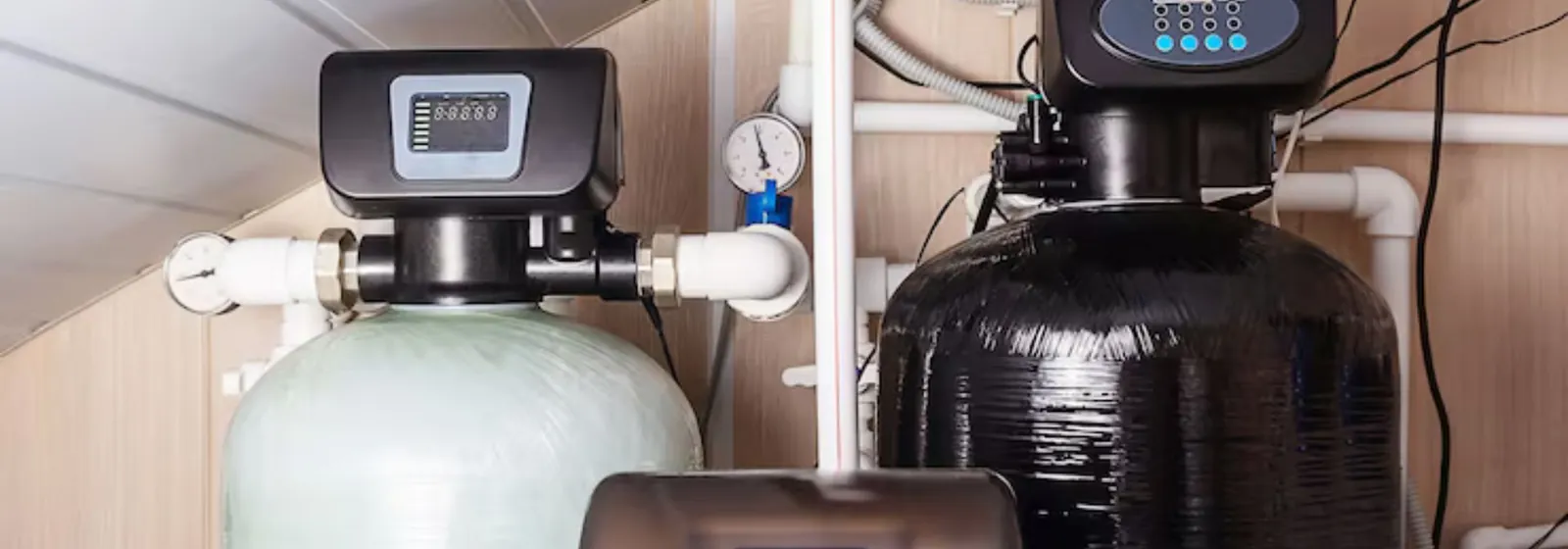
Scale, spotty dishes or odd-tasting water?
White crust on fixtures, spots on glasses, cloudy water, a chlorine smell or a gritty sediment each point to a different problem. Some are about minerals, some about particles or taste. A softener, a filter or a reverse osmosis system fixes different ones, so the first step is to find out which you have.
Test your tap before you buy anything
A hardness strip from a hardware store is a fair starting point for a city water home. It tells you roughly how mineral-heavy the water is, but not what else is in it. A lab test is better when you want numbers you can size equipment against.
If you are on city water, call Palm Beach County Water Utilities at (561) 740-4600 and ask for its current water quality report and hardness. If your address is south of Southern Blvd, Wellington Utilities at (561) 791-4010 is your provider instead.
Write down the result and bring it to the call. It changes the unit size, the salt use and whether you need pre-filtering at all.
City water or private well water
Most of Royal Palm Beach is on county water, so the question is usually scale, taste or chlorine. Private wells are a different case. Wells are common in neighboring Loxahatchee Groves, where the town does not provide water or sewer service, and in The Acreage.
Well owners are responsible for their own water. The Florida Department of Health recommends testing a private well for bacteria and nitrate at least once a year and for lead about every three years, using a state-certified lab. The state has no requirement for routine sampling, so nobody will remind you.
Treatment on a well starts with the lab report. Iron, sulfur smell, bacteria and nitrate each need their own approach, and a softener alone handles none of the last two.
Softener, filter or reverse osmosis: which fits
| Your problem | Best fit | Honest limit |
|---|---|---|
| White scale, soap that will not lather | Salt-based softener | Does not make water safer to drink |
| Chlorine taste or smell | Carbon filter | Ask the maker which products suit chloramine |
| Sediment or cloudy water | Sediment filter | Needs regular cartridge changes |
| Drinking water quality at one tap | Reverse osmosis under the sink | Treats one tap, wastes some water |
| Well with iron or sulfur | Lab test, then iron or aeration treatment | Cannot be picked without results |
| Bacteria or nitrate in a well | Treatment chosen from lab results | A softener will not remove these |
What each system does and does not do
Water softener
- Swaps calcium and magnesium for sodium or potassium
- Protects fixtures, water heater and appliances from scale
- Needs a drain line and salt
- Does not remove chlorine, bacteria or nitrate
Filters and reverse osmosis
- Carbon filters improve taste and odor
- Sediment filters remove particles
- RO polishes drinking water at one tap
- None of these remove hardness well on their own
Salt-based or salt-free
Salt-based softeners remove hardness minerals through ion exchange. They are the proven option for stopping scale, but they use salt, power and a drain for the brine. Some areas restrict where that brine may discharge, so ask the building department.
Salt-free units do not remove hardness. They condition it so scale clings less, and results vary by water and product. If you are comparing, look for third-party certification marks such as NSF/ANSI, and ask for the test data behind any scale claim.
A note on chloramine
PBCWUD disinfects with chloramine, and it switches to free chlorine twice a year for pipe cleaning. Some carbon filters address taste and odor from disinfectants. We do not claim a removal rate, so check the manufacturer's specification for chloramine before you buy.
Water conditioner repair
If your existing unit stopped softening, the usual suspects are a salt bridge in the brine tank, a clogged injector, an exhausted resin bed or a failed control valve. Overflow often traces to a stuck float or a clogged drain line. Tell us the brand and age on the call so we can bring the right parts.
How we install it
- 1
Pick the location
Close to the main line, with a floor drain or standpipe, a grounded outlet and room to carry salt bags.
- 2
Set up bypass and connections
Shutoff and bypass valves go on the incoming line so you can isolate the unit. Hardness-sensitive fixtures such as outdoor spigots are usually left on raw water.
- 3
Connect drain and power
The brine drain gets an air gap. The control valve is programmed from your test result.
- 4
Start up and test
We flush the resin, run a regeneration cycle and test the water at a tap. You get the settings and the salt schedule.
Maintenance that keeps it working
- Check the salt level monthly and keep it above the water line
- Break up any salt crust or bridge with a broom handle
- Clean the brine tank once or twice a year
- Replace sediment and carbon cartridges on the maker's schedule
- Look under the unit for drips at the bypass and drain
Permits and licensing
A softener tied into your supply line is plumbing work, so call the Village building department at (561) 790-5128 to ask if it needs a permit. Check any contractor's license at MyFloridaLicense.com. The Florida Building Code, Plumbing, 8th Edition (2023) is the edition in effect.
We price after your test result and a look at the location.
Unit size and brand
Capacity is chosen from your water test and household size, and models vary widely.
Location and piping
A short run beside the main is quick. A long run, a second floor or a tight closet adds parts and labor.
Drain and power
If no drain or outlet is near, we run one, which adds work.
Pre-filtering
Sediment or iron treatment ahead of the softener adds equipment.
Ongoing costs
Salt, cartridges and water use are yours to budget for, and we explain them up front.
Water treatment is rarely covered by home insurance. Call (561) 448-8545 and we give a clear price before work starts.
Call and tell us your symptoms and where your water comes from. We will explain the test and the options.
Local water notes
County water in the Village
PBCWUD draws from the Biscayne Aquifer for its eastern system and uses chloramine. Ask for its hardness and quality report, since we have no published figure to quote.
Water heaters and scale
Scale builds inside tank heaters over time, so a softener helps only if hardness is high. Our water heater installation page explains how to plan the two together.
Sources and standards
The Florida Department of Health recommends that private well owners test for bacteria and nitrate at least once a year and for lead about every three years, using a state-certified lab, according to its private well guidance. City water customers can ask Palm Beach County Water Utilities for its annual water quality report.
Royal Palm Beach water softener questions
Why are there white spots on my dishes and faucets, and do I need a softener?
White crust and spotty glasses are usually mineral scale from hard water. A test confirms it, and a softener is the usual fix. If the test shows moderate hardness, a smaller step may do.
How hard is my water in Royal Palm Beach?
We do not quote a number because the sources we trust do not publish one. Ask PBCWUD at (561) 740-4600 or test your tap.
Do I need a softener if I am on well water?
Maybe, but test the well first. Florida Department of Health recommends bacteria and nitrate testing once a year at a state-certified lab.
Will a softener make my water safe to drink?
No. A softener targets hardness minerals. It does not treat bacteria, nitrate or most contaminants.
Does a carbon filter remove chloramine?
Some address taste and odor, but we do not claim removal rates. Check the manufacturer's specification for chloramine.
Can you repair my existing softener?
Often yes. Share the brand, age and symptom and we confirm what we can service.
Question not answered here? Call the 24/7 line at (561) 448-8545 and talk to a plumber.