

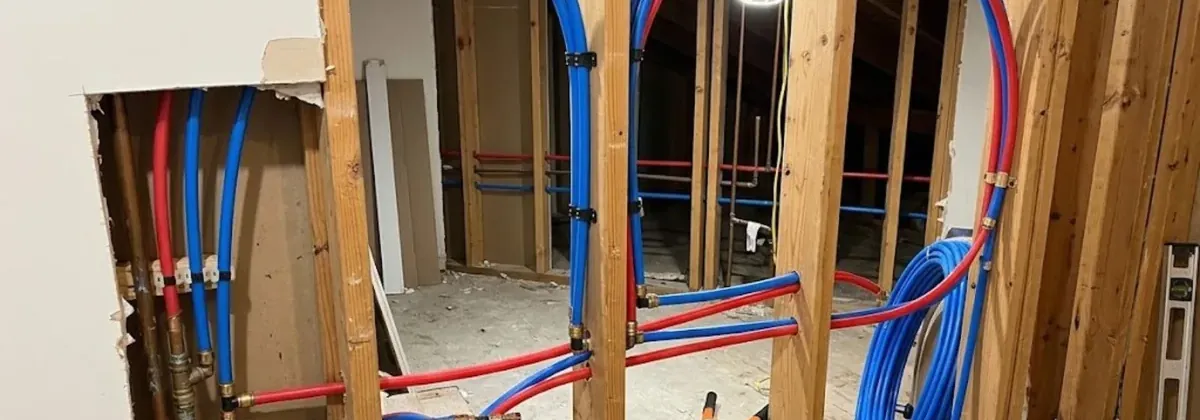
Rusty water, repeated pinhole leaks or falling pressure?
These three symptoms often point to the same cause: supply pipe that is wearing out from the inside. A single fix may hold for a while, but when the pattern repeats, the lasting answer is repiping. That means replacing the old lines with new PEX or copper in a planned job.
What a whole-house repipe replaces
A repipe swaps the hot and cold supply lines that run from your main shutoff valve to each fixture. It usually includes new shutoff valves under sinks and toilets, and often new lines to the water heater. Drain and sewer pipes are a different system and are judged separately.
Most homeowners reach this decision after the second or third leak in the same house. One pinhole is a repair. A string of them in different rooms means the pipe itself has aged out, and every patch just moves the pressure to the next weak spot.
Signs your supply pipes are near the end
Brown or orange water
Rust from the inside of old steel pipe shows up when you first open a tap after the water has sat. If it clears in a minute or so, the pipe is shedding scale.
Pressure that fades
Good pressure at the meter but weak flow at the shower points to a narrowed pipe. Mineral and rust buildup can shrink the opening to a fraction of its original size.
Leaks in new places
A repair at one joint, then a drip two feet away a month later. That pattern is the pipe failing along its length, not at one bad fitting.
Stains and green crust
Blue-green crust at copper joints, or flaking rust at steel fittings, shows the metal is corroding where you can see it. It is usually worse where you cannot.
Water bill creeping up
A hidden leak inside a wall adds to the bill before it stains anything. Test the meter first, and if it moves with everything off, start with leak detection.
Pipe material you cannot name
If you bought the house and no one knows what is behind the drywall, a quick look at the lines near the water heater and main valve usually answers it. We can do that on the first visit.
Galvanized pipe replacement
Galvanized pipe is steel with a zinc coating, common in older houses. The zinc wears off over the years, and then the steel rusts from the inside out. The pipe can look fine on the outside while the bore closes up like a clogged artery.
Patching a galvanized line rarely fixes the real problem, because the next joint is in the same condition as the one that failed. Where new copper or PEX meets old steel, we use a dielectric fitting so the two metals do not corrode each other at the connection.
If a galvanized section bursts before your repipe is scheduled, close the main valve and call the line. We can make a safe repair or stop-gap, and then plan the full replacement properly. For an active break, burst pipe repair is the faster route.
Polybutylene: why some homes were repiped
Polybutylene is a gray, sometimes blue or black, flexible plastic pipe used in many U.S. homes from the late 1970s into the mid 1990s. It was cheap and fast to install. It also earned a bad reputation, and a large class-action settlement followed.
The usual complaint is failure at the fittings, often with little warning, and sometimes the pipe wall itself. Many owners replace it before a leak happens, and some insurers ask about it when you apply for coverage, so check with yours. We cannot tell you how many local homes have it, but we can identify it in minutes by looking at the pipe near your water heater and main shutoff.
PEX or copper: the honest trade-offs
Both materials work for a whole-house repipe, and neither is perfect. The better pick depends on your house, your water and your budget, so we explain the choice on the call instead of pushing one.
| Factor | PEX | Copper |
|---|---|---|
| Installation | Flexible tubing, fewer cuts into walls | Rigid, needs more joints and more access |
| Joints | Crimp or expansion fittings, no flame | Soldered joints, done by a skilled hand |
| Material cost | Usually lower | Usually higher, and prices swing |
| Sunlight | Cannot sit in sun, degrades with UV | Unaffected |
| Noise and flow | Quiet, slight bend losses | Can ring or knock if loosely strapped |
| Water chemistry | Not affected by corrosion | Can pit with some water conditions |
| Repair later | Simple with the right fittings | Straightforward for a plumber |
| Fire and heat | Melts in a fire | Does not burn |
In practice, PEX wins on speed and wall damage, and copper wins on long track record and heat tolerance. If you drink well water or have unusual water, ask for a test before choosing copper.
What a repipe actually involves
- 1
Pipe survey and plan
We trace your lines, check the main valve, pressure and water heater connections, and decide which walls, ceilings or closets we need to open. You get the scope and a clear price in writing before anything is cut.
- 2
Permit and water schedule
We confirm the permit path with the building department. Water is not off for the whole job. The work is planned in phases, so ask on the call how your house would be split up.
- 3
New lines and connections
We run new supply lines to each fixture, install new shutoffs, and reconnect the water heater, the washer box and the ice maker line. Old pipe is cut out or abandoned in place, depending on the wall.
- 4
Pressure test, inspection, patch
The system is pressure tested before walls are closed, and inspected where a permit requires it. Then we patch the access holes in drywall. Ask what level of finish is included, since paint matching is a separate question.
Repair, partial repipe or full repipe
Repair or partial repipe fits when
- Only one run, such as a single bathroom line, is failing
- The rest of the pipe tests sound and looks clean inside
- You are selling soon and need a limited fix
- You want to spread the cost across two projects
Full repipe fits when
- Leaks keep appearing in different rooms
- Water is discolored or pressure has dropped at several fixtures
- You have polybutylene or heavily corroded galvanized steel
- You are already opening walls for a remodel
Permits and checking your plumber
Call the Village building department at (561) 790-5128 before the work starts. The Village states that most work done in Royal Palm Beach requires a building permit, and the Florida Building Code, Plumbing, 8th Edition (2023) is the edition in effect. Owner-builder permits need a notarized affidavit, so a plumber who skips this step is worth questioning.
Check any contractor's license at MyFloridaLicense.com using the Verify a License tool, by name, business or number. If your home sits in Wellington instead, the permit office is the Wellington building division, which lists its own plumbing permit packet.
Every house is different, so we price the job after we see it.
Size and layout
Square footage and bathroom count matter. So does whether lines run through an attic, a slab or a second story, since each changes the pipe and labor.
Pipe material
PEX and copper are priced differently, and copper prices move with the metal market.
Wall and ceiling access
More drywall to open and patch means more labor, and finished tile or cabinetry adds care.
Fixture count and shutoffs
New shutoff valves, a new main valve or a pressure regulator add parts and time.
Permit and inspection
Permit fees and inspection steps are set by the building department, and we include them in the plan.
Insurance may cover water damage from a sudden leak, but it rarely pays to replace pipe that is simply old. Ask your carrier first, then call (561) 448-8545 for a clear price before work starts.
Call and describe your pipe, your leaks and your timeline. We will tell you what to check and what a visit covers.
What to expect after a repipe in Royal Palm Beach
Know your water provider
Palm Beach County Water Utilities serves most of the Village, but addresses south of Southern Blvd are on Wellington Utilities. Tell us which one you use, since it affects who to call about the meter and main.
Flush and clean the aerators
PBCWUD reports no lead service lines found in its service area, and lead at the tap usually comes from household plumbing. After a repipe, run the taps and clean the aerators to clear debris, then test if you have concerns.
Related planned plumbing work
A repipe is a good time to handle other planned work in the same walls. If a water heater swap or new fixtures are on your list, ask about plumbing installation so one crew handles both. For one broken underground line, water line repair is usually enough.
Sources and standards
A repipe is built to the Florida Building Code, Plumbing, 8th Edition (2023) and the Village of Royal Palm Beach states that most work in the Village requires a permit, so call (561) 790-5128 before starting. Check any contractor's license at MyFloridaLicense.com, the state's license lookup.
Royal Palm Beach repiping questions
Why is my water rusty or brown, and does it mean I need new pipes?
Brown water that clears after a minute often means old steel pipe is shedding rust. If it happens at several taps and comes with falling pressure, the supply lines are likely failing. A visit confirms the pipe type and whether a repipe is the right fix.
How do I know if my house needs a repipe?
Repeated leaks in different spots, discolored water and low pressure at several fixtures are the main signs. Pipe material matters too, since galvanized steel and polybutylene both have known problems. A visit lets us look at the pipe instead of guessing.
How long will my water be off during a repipe?
We plan the work in phases, so water is usually restored between stages. The exact schedule depends on your layout, so ask on the call and we will describe how your house would be divided.
Do I need a permit to repipe my house?
Most plumbing work in the Village needs a permit. Call the Village building department at (561) 790-5128 to confirm, and we handle the permit steps for the work we do.
Will you cut into my walls?
Usually yes, but only where needed. We plan access holes in closets, behind cabinets and in attics where possible, then patch the drywall. Ask what finish is included.
Is PEX better than copper?
Not always. PEX is quicker to install and quieter, and copper has a longer track record and handles heat. We explain which one suits your house before you decide.
Do you replace drain lines too?
This service covers water supply lines. If you suspect a broken or old drain, we can look at it with a camera, and the sewer inspection page explains that process.
Question not answered here? Call the 24/7 line at (561) 448-8545 and talk to a plumber.