

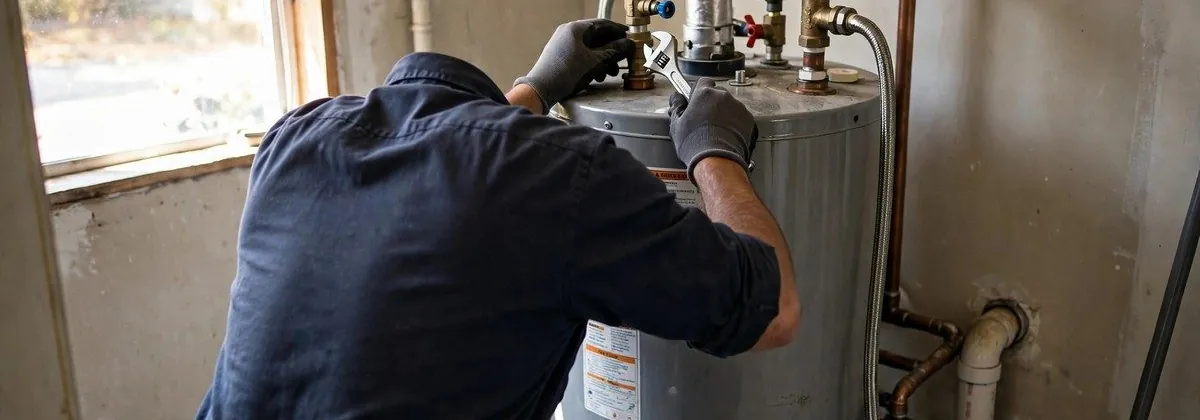
What a water heater repair visit covers
A repair visit means we find the failed part and replace only that part. On a tank heater the usual suspects are the heating elements, thermostats, gas control valve, thermocouple, igniter, relief valve, drain valve and the supply fittings on top. On a hybrid heat pump unit we also look at the fan, the condensate drain and the control board.
We bring a multimeter, a pressure gauge and common parts for popular tank sizes. If the tank itself has rusted through, we tell you plainly, because no repair fixes that. In that case the next step is a water heater replacement, and we explain the choices before any work begins.
When a water heater problem is an emergency
A heater that is only lukewarm can wait until morning. A heater that is leaking, scalding, rumbling loudly or running with a hot discharge pipe cannot, and neither can any unit in a closet over finished flooring. Call the 24/7 line any hour, including nights and weekends.
Do this while you wait for the plumber
If you smell gas, leave the building first and call the gas utility or 911 before you call us. Never relight a pilot when you smell gas.
- Turn the power off at the breaker for an electric unit, or turn the gas control to off.
- Close the cold water shutoff on the pipe above the tank.
- Move rugs, boxes and stored items away from the water.
- Open a hot tap upstairs only if the tank is leaking, to ease pressure.
- Keep children and pets away from a hot, steaming relief pipe.
No hot water: what we check first
A heater that makes no hot water at all usually has lost its power or its flame. On electric tanks the first stops are the tripped breaker, the reset button on the upper thermostat and the two heating elements. On gas tanks we check the pilot or igniter, the thermocouple and the gas control valve.
Hot water that runs out fast points somewhere else. A failed lower element, a sediment-packed tank or a broken dip tube can each leave you with a few minutes of heat. Water that is hot at one faucet and cool at another is often a mixing valve or a crossed line, not the heater at all.
Electric, gas or hybrid heat pump: what fails on each
| Type | Typical failures | What the repair involves |
|---|---|---|
| Electric tank | Dead element, bad thermostat, tripped high-limit | Test with a meter, swap the part, refill and check for leaks |
| Gas tank | Weak thermocouple, dirty burner, failed gas control | Clean or replace the part, then test the flame and draft |
| Hybrid heat pump | Blocked condensate drain, fan fault, control error | Clear the drain, check airflow, read the fault code |
| Any tank | Leaking relief valve or drain valve | Replace the valve and inspect the discharge pipe |
Hybrid units need open air around them and a condensate line that drains freely. If one stops heating, it often falls back on its electric elements, which keeps hot water coming at a higher energy cost. We can tell you which mode it is running in and why.
Water heater leaking: fittings, valve or tank?
A leak at the top of the heater is often cheap to fix. Loose or corroded supply connections, a weeping relief valve and a dripping inlet nipple can all drip down the side and look like a failed tank. We dry the unit, add a paper towel at each joint and watch where the first drop forms.
A leak from the bottom is different. Water that seeps from the base seam or soaks the insulation means the steel liner has failed. That tank cannot be patched, so you will want to read about replacing the heater instead of paying for a repair that will not hold.
Relief valve, anode rod and expansion tank problems
The temperature and pressure relief valve is the safety device that opens when the tank gets too hot or too high in pressure. A valve that drips now and then can mean thermal expansion in a closed system, and one that blows hard may mean a thermostat that has stuck on. We test the valve and trace the real cause instead of just swapping it.
The anode rod is a metal rod inside the tank that corrodes first so the steel lining does not. Many tanks are at the end of their life after around a decade, and a worn rod is one reason. An expansion tank on the cold line absorbs pressure swings, so a waterlogged one can make the relief valve spit.
Drain pan and relief pipe: where the water goes
Heaters in garages, closets and utility rooms sit on a drain pan with a pipe that carries overflow outside or to a safe drain. A blocked pan line, a cracked pan or a relief discharge pipe that ends in the wrong place turns a small drip into a soaked wall. We check all three whenever we open a repair on a leaking unit.
- 1
Make it safe
We confirm the power or gas is off, close the cold supply and note any leak, steam or scorch marks.
- 2
Test and isolate
A multimeter checks elements and thermostats. A gauge reads supply pressure, and a flame and draft check covers gas units.
- 3
Explain the options
You hear what failed, what the part and labor involve and whether repair or replacement makes more sense. The price is clear before work starts.
- 4
Repair and retest
After the new part goes in, we refill the tank and purge the air. Then we restore power and confirm hot water at the tap with dry joints.
Repair or replace: an honest way to decide
Repair usually makes sense when
- A single part has failed, such as an element, thermostat or valve
- The tank is dry on the outside and the base is intact
- The unit is in its middle years and has been working well
- The problem is a fitting, a valve or a drain pan line
Replacement usually makes sense when
- Water seeps from the base seam or soaks the insulation
- The tank is rusty and heavily scaled after long service
- Repair cost approaches the cost of a new unit
- Rumbling and short hot water point to a sediment-packed tank
Water quality and your heater in Royal Palm Beach
Palm Beach County Water Utilities supplies most Royal Palm Beach homes, drawing from the Biscayne Aquifer and disinfecting with chloramine. The county does not publish a hardness figure in the reports we reviewed, so ask the utility at (561) 740-4600 for current hardness. Harder water builds scale on elements faster, which is worth knowing before you decide how often to flush the tank.
Addresses south of Southern Blvd are instead served by Wellington Utilities, so the right number to call depends on where you live. We also serve Wellington directly if your home sits across that line.
Repairs vary a lot, so we price the real fault rather than a flat guess.
The part that failed
An element or thermostat costs far less than a gas control valve or a heat pump control board.
Tank type and size
Gas, electric and hybrid units use different parts, and a few models need special-order components.
Access and location
A heater in an attic or tight closet takes longer to work on than one in an open garage.
Condition of the tank
A tank in poor condition may not be worth repairing, which changes the recommendation.
Time of the call
Night and weekend dispatch can cost more than a scheduled daytime visit.
Some homeowner insurance policies cover sudden water damage but not the heater itself, so keep your photos and invoice. Call the 24/7 line and we will give you a clear price before work starts.
Our 24/7 line is staffed around the clock and sends a licensed, insured plumber. Call now and tell us what you see.
Know which utility serves you
Most of the Village is served by Palm Beach County Water Utilities at (561) 740-4600, while addresses south of Southern Blvd use Wellington Utilities at (561) 791-4010. Calling the right one gets you a faster answer on water pressure or quality.
Check permits first
Most work in the Village needs a building permit, and the Village does not publish a water heater rule of its own. Call the Village building department at (561) 790-5128 before any replacement.
Verify your plumber
You can confirm any plumber's license at MyFloridaLicense.com under Verify a License. It takes a minute and protects you.
Sources and standards
Relief valves, drain pans and discharge piping are installation standards found in the Florida Building Code, Plumbing, 8th Edition (2023). The Village of Royal Palm Beach publishes no water heater specific rule, so call its building department at (561) 790-5128 before replacing a unit.
Royal Palm Beach water heater repair questions
Do you handle water heater repair emergencies at night or on weekends in Royal Palm Beach?
Yes. The 24/7 line takes calls through the night and all weekend, and we dispatch a licensed, insured plumber for leaks, scalding and heaters that lose power.
Same-day appointments are available when the schedule allows, and you get a clear price before work starts.
My water heater has no hot water. What should I check before calling?
Look at the breaker for an electric unit, or check whether the pilot is lit on a gas unit. If a breaker keeps tripping, do not keep resetting it, because that points to a failed element.
If you smell gas, leave and call the gas utility or 911 first.
Is the leak from the tank or from a fitting?
Dry the heater and check the top connections, the relief valve and the drain valve first. If water comes from the base or the jacket is soaked, the tank itself has failed.
We can usually tell on the first visit and explain whether repair is worth it.
Why does my relief valve keep dripping?
It can mean pressure from thermal expansion, a worn valve seat or a thermostat that is overheating the tank. A waterlogged expansion tank also causes it.
We test pressure and temperature before replacing the valve, so the drip does not return.
Can you repair a hybrid heat pump water heater?
Yes, for common faults such as a blocked condensate drain, airflow trouble and fault codes. Some control board work may need a manufacturer part.
We tell you early if a part must be ordered.
Can a gas, electric or hybrid unit be repaired the same day?
Often, when the part is common and the unit is in sound condition. Special-order parts or a failed tank can push the fix to a second visit or to replacement.
Question not answered here? Call the 24/7 line at (561) 448-8545 and talk to a plumber.