

Meter spinning with everything off, or water showing up where it should not?
Most people reach us before they know the word for the fix. They see a meter that will not sit still, a bill that makes no sense, or a stain that keeps growing. All of those point to the same job, which is leak detection: finding where the water is escaping before anything gets opened.
What leak detection actually is
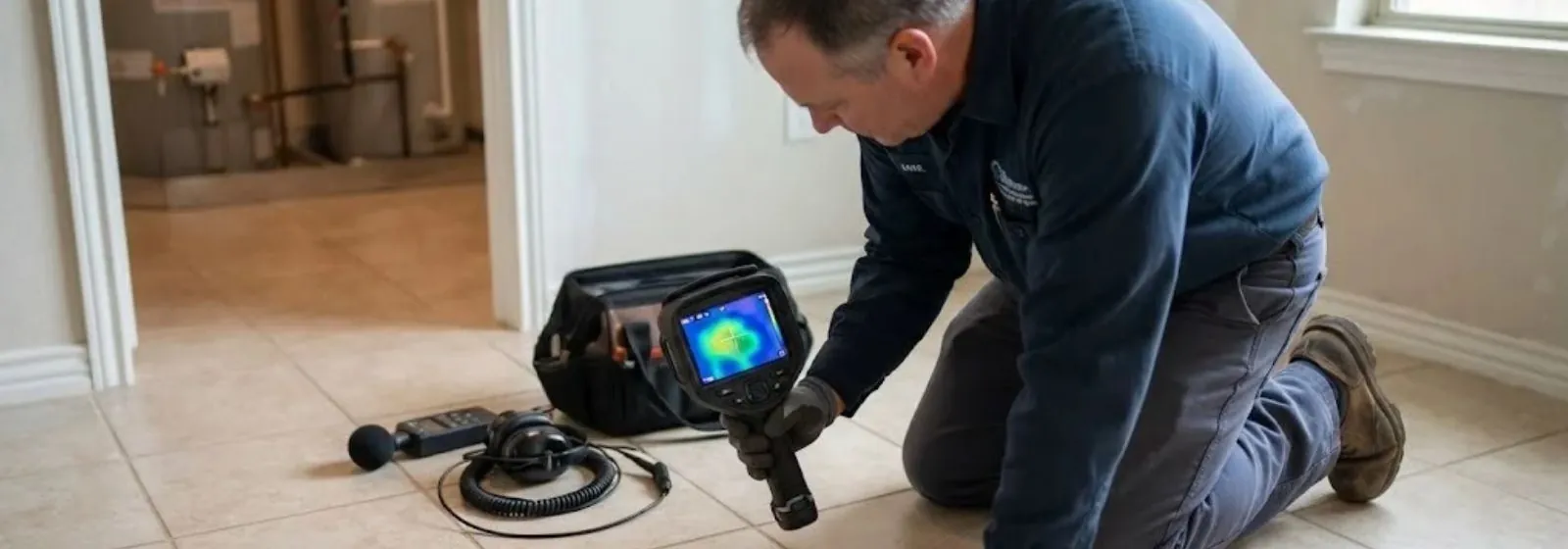
Leak detection is the work of locating a leak before anyone cuts into anything. A plumber uses sound, pressure, moisture and heat readings to pinpoint where water is escaping, so the repair opens up one small spot instead of a whole room.
Most hidden leaks sit in supply lines that stay under pressure all day, so they keep losing water even when every faucet is off. That is why the first test is simple: shut everything off and see whether your water meter still moves.
When a leak counts as an emergency
Do these things while the plumber is on the way
Not every leak is a rush, but these situations are. If any of them match, act now and then call the 24/7 line.
- Water is dripping through a ceiling or bulging the drywall: turn off the main valve, then switch off power to that room at the breaker if you can reach the panel dry.
- Water is pooling on the floor and you cannot see where it comes from: shut the main valve and photograph the wet area.
- Your meter is spinning with every fixture closed: note the reading and the time, and do not run washers or sprinklers.
- You smell gas at any point: leave the building and call the gas utility or 911 before you call a plumber.
- The wet spot is near outlets, a light fixture or the electrical panel: stay out of the room and call us.
Slow leaks are still worth a same-day call when a plumber can fit you in. A small leak inside a wall does damage every hour, because drywall wicks water upward and the cavity stays damp long after the drip is hidden. After hours and on weekends the 24/7 line works the same way, and our dispatcher will tell you whether it can wait until morning.
Water meter still running or a high water bill
A bill that jumps with no change in how many people live in the house is the most common reason people call us. The meter test is free to do yourself. Turn off every faucet, the ice maker, the irrigation controller and the washing machine, then look at the small triangle or dial on the meter face.
If the dial or low-flow indicator keeps turning, water is leaving somewhere. The leak can be inside the house, in the yard, or in the line between the meter and the house. A toilet flapper that seeps is the cheapest culprit, so check that first by dropping a little food coloring in the tank and waiting without flushing.
When the toilets are clean and the meter still moves, we split the system in two. Closing the house main tells us whether the loss is on your side of the shutoff or on the line ahead of it. That one step decides whether we trace pipe inside walls and slab or dig for a buried line, and you can read about the second case under water line repair.
Billing in Royal Palm Beach comes from Palm Beach County Water Utilities at (561) 740-4600. Addresses south of Southern Blvd are billed by Wellington Utilities at (561) 791-4010. Call whichever one sends your bill if you want to ask about meter reads or past usage, since they hold the history we cannot see.
Ceiling and wall leaks
A brown ring on a ceiling, bubbling paint or a soft patch on a wall means water has already travelled. It rarely sits above the stain, because water follows joists and pipes before it shows. Our plumber starts with a moisture meter to map the damp area, then uses a thermal camera to see cold or warm lines behind the surface.
Common sources are a supply line to an upstairs bathroom, a shower pan, a water heater drain pan overflow, an air conditioner condensate line and a cracked drain joint. Only some of those are plumbing, and we tell you plainly when the cause is the condensate drain or the roof so you call the right trade. If the ceiling sags, keep people out from under it, because wet drywall can drop without warning.
Crawlspace or raised-floor leaks
Many Florida homes are built on a concrete slab, so true crawlspaces are the exception here. If your house, an addition or an older outbuilding sits on a raised floor or a crawlspace, the leak is often easy to reach once someone gets underneath. Signs include a musty smell, a floor that feels springy, swollen baseboards and a meter that keeps turning.
We look for dripping fittings, corroded copper, split supply lines and wet insulation, and we check that the soil beneath is not staying soggy. Standing water under a house also attracts pests, so a quick find matters. For a slab foundation the same problem looks different, and our slab leak repair page covers those cases.
Buried line leaks
A buried leak is the hardest to see because the symptoms show up in the yard instead of the house. Look for a patch of grass that stays green or soggy in dry weather, a sunken spot, low pressure at every tap, or a meter that runs when nothing inside is open. The pipe in question is usually the service line between the meter box and the house.
We confirm it with a pressure test on the line and ground microphones that pick up the hiss of escaping water. Then we mark the spot so the repair is a short trench or a pipe pull instead of a ripped-up lawn. Because this work often leads to digging, we explain the options and the price before we start.
How we find a hidden leak
- 1
Isolate the system
We close the main, read the meter and watch it. If the dial stops, the leak is on the house side of the valve. If it keeps moving, the leak is outside or on the supply side.
- 2
Pressure test the lines
A gauge on a hose bib or the water heater connection shows whether the pipes hold pressure. A fall in pressure with everything closed confirms a leak and helps us split hot from cold.
- 3
Listen and scan
An acoustic microphone picks up the sound of a leak. A moisture meter maps wet material, and a thermal camera shows temperature changes behind walls and floors.
- 4
Mark it and give the plan
We mark the exact spot, explain the repair, and give a clear price before work starts. You decide before anything is opened.
Commercial leak detection: what we can and cannot do
We do trace leaks in small shops, offices, restaurants and strip-center units, with the same tools we use at a house. We can test a unit, find the leak on the tenant's side and repair it when it is on that plumbing.
There are limits. Large buildings with several tenants, shared risers, fire sprinkler lines or roof drains often need a facility manager, a landlord's approval or a specialty trade, and some jobs are better handled by them. We will say so on the phone instead of sending a truck that cannot finish the work. For general commercial plumbing needs see commercial plumbing.
Irrigation, pool and yard leaks
Irrigation leaks are easy to miss because sprinklers run in the early morning. A broken head, a cracked valve or a split lateral can empty a lot of water into one bed. The SFWMD year-round rule bans watering from 10 am to 4 pm, so check that your timer is not running during those hours, and run each zone by hand to look for pooling.
Pool and spa leaks are checked at the equipment pad and the plumbing lines running to and from the pump, heater and filter. We do not repair pool shells, liners or tile, so if the loss is in the pool itself you will need a pool specialist. We can tell you whether the plumbing side is tight.
Meter-box and yard leaks deserve a quick look too. Lift the meter box lid if it is safe to do so and check for standing water around the fittings. If water is collecting at the meter itself, leave the utility's valve alone and call the utility, because the meter belongs to them. If it is the line after the meter, call us.
Leak repair options once we find it
| Where the leak is | Usual fix | What to expect |
|---|---|---|
| Exposed or wall supply line | Cut out the bad section and replace it | Small opening in drywall, patch afterward |
| Under a slab | Spot repair or reroute overhead | See the slab leak page for the trade-offs |
| Between meter and house | Short trench repair or line replacement | Yard disturbance, sometimes trenchless |
| Irrigation lateral | Replace the broken section or head | Usually a shallow dig |
| Fixture or valve | Replace the part | Often same visit when parts allow |
You get a clear price before work starts, and the factors below are what move it.
How hard the leak is to reach
A leak under a tile floor costs more to open and restore than one behind a removable access panel.
How long the search takes
A single failed fitting is quick to find, while a slow leak on a long line takes more testing.
Pipe material
Copper, CPVC, PEX and galvanized each repair differently and need different parts.
Whether digging is involved
Yard and buried line work adds trenching, backfill and sometimes utility locating.
After-hours timing
A night or weekend dispatch can change the visit cost, and the dispatcher states it before anyone heads out.
Insurance policies treat hidden leaks very differently, so ask your carrier what is covered. We can describe what we found in plain terms for your adjuster. Call the 24/7 line and we will explain the price first.
Call the 24/7 line and a dispatcher will help you decide whether it needs a plumber tonight.
Why leaks are worth catching early in Royal Palm Beach
Two utilities, two numbers
Most Village addresses use Palm Beach County Water Utilities, but anything south of Southern Blvd uses Wellington Utilities. Knowing which one bills you saves a wrong call when you need meter history.
Mostly owner-occupied homes
About 82 percent of the roughly 14,700 housing units are owner-occupied, so the repair bill and the water damage land on the homeowner. A leak caught early is far cheaper than drywall, flooring and mold work.
Chloramine in the water
The eastern county system disinfects with chloramine, which can be tough on some rubber parts and old fittings over time. If you see repeated failures on flappers or supply hoses, mention it to the plumber.
Sources and standards
The water meter test and shutoff steps here are standard homeowner practice, and any pipe repair that follows is held to the Florida Building Code, Plumbing, 8th Edition (2023). Palm Beach County Water Utilities, at (561) 740-4600, can answer billing and meter questions according to its customer service line.
Royal Palm Beach leak detection questions
Do you handle leak detection emergencies at night or on weekends in Royal Palm Beach?
Yes. The 24/7 line is staffed around the clock, so a ceiling leak at night or a running meter on a weekend gets the same dispatch as a weekday call.
The dispatcher asks a few questions and tells you what to shut off while a licensed plumber is sent.
Why is my water meter still moving when everything is turned off?
Something is using water that you are not seeing. Common causes are a seeping toilet flapper, a leaking irrigation valve, a pinhole in a supply line or a break in the line to the house.
Our plumber closes the house main to learn which side of the valve the loss is on, then traces it from there.
How do I know if my water meter shows a leak?
Close every tap and appliance that uses water, then watch the meter dial for a minute or two. If the dial or low-flow marker keeps moving, water is escaping somewhere.
Write down the reading before and after so you can tell us how fast it is moving.
Will you have to cut into my walls or floors?
Usually only one small spot. The tools find the leak first, so the opening is made where the water actually is.
If a leak is under a slab and rerouting is better than opening the floor, we explain both choices before starting.
My bill went up but I see no water. Where do I start?
Do the meter test above, then check toilets for a slow flapper leak. Look over the irrigation system too. If the meter still turns, call us.
For past bills, call the utility that sends yours. That is Palm Beach County Water Utilities at (561) 740-4600 or Wellington Utilities at (561) 791-4010.
Can you find a leak in my pool?
We check the equipment pad and the plumbing lines to and from it. We do not repair pool shells, tile or liners, so a leak in the pool itself needs a pool specialist.
If our test shows the plumbing is tight, that at least narrows your search.
Is leak detection the same as leak repair?
No. Detection finds and marks the leak, and repair fixes it. Many visits do both, because once the spot is found a short repair often follows.
You always get a clear price before work starts, so you can approve the repair or take the findings to someone else.
Question not answered here? Call the 24/7 line at (561) 448-8545 and talk to a plumber.