

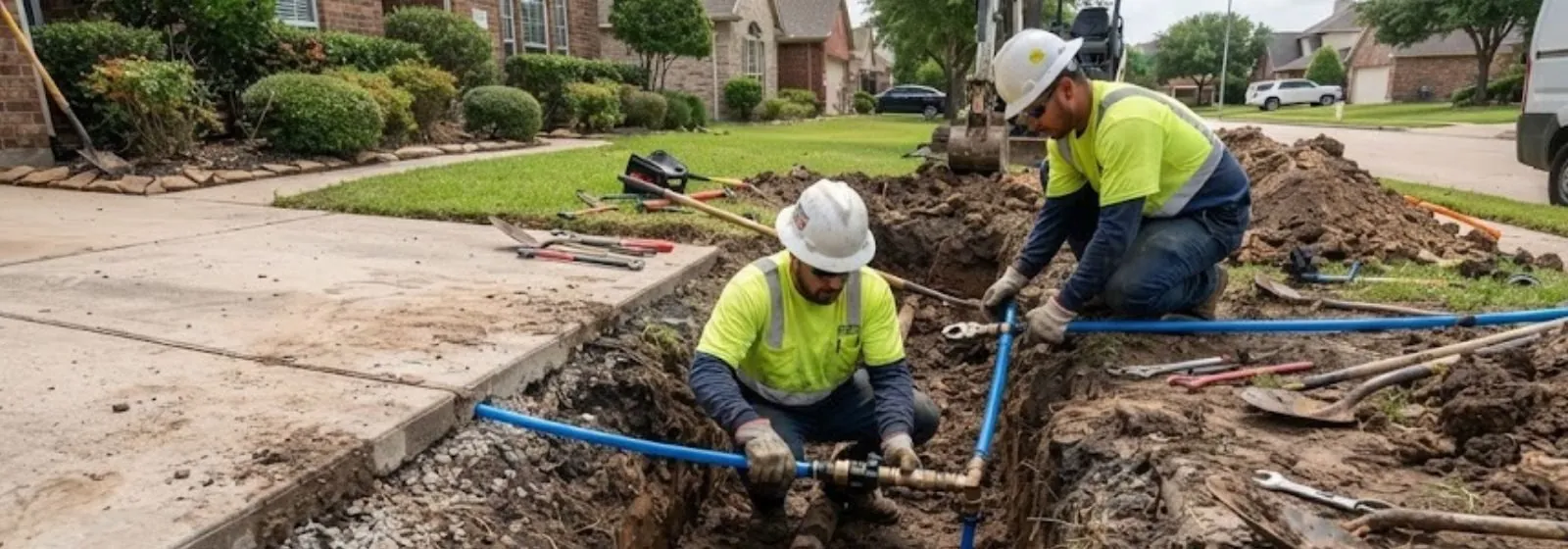
Wet patch in the yard, a meter that will not stop, or low pressure everywhere?
Those three symptoms often come from the same place: the water service line that runs underground from the meter to the house. Soggy grass in dry weather, a dial turning with the taps closed or a weak shower at every fixture all point to it. Fixing that pipe is what water line repair means.
What a water service line is
It is the buried pipe that carries water from the utility's meter to your house. Everything on your side of the meter is yours to maintain, which includes the line and the shutoff where it enters the house. The meter itself belongs to the utility.
Older lines are often galvanized steel, copper or polybutylene, and newer ones are PEX or PVC. Roots, shifting soil, corrosion and past digging can all damage them. When one fails, it leaks into the ground, so you may not see water at all.
When a water line problem is urgent
What to do before we arrive
Keep it simple. The goal is to stop the loss and keep the house safe.
- Find your house shutoff, often near where the pipe enters the home, and close it. If there is no working shutoff, tell the dispatcher.
- Do not dig into wet ground or open the meter box beyond a quick look.
- If water is surfacing, keep children and pets away from the soft spot.
- Avoid using irrigation, washers and dishwashers until the line is fixed.
- If the meter itself is leaking, call the utility. Palm Beach County Water Utilities is at (561) 740-4600, and Wellington Utilities at (561) 791-4010 serves addresses south of Southern Blvd.
A broken service line can wash out soil under a driveway or walkway. After hours and weekends we treat a flowing line as an emergency, and the dispatcher asks a few questions about the location before sending a plumber.
Signs the service line is failing
Soggy or sunken ground
A green, wet or collapsed spot between the meter and the house points to a buried leak.
Meter moving with taps closed
Close every fixture and read the dial twice a few minutes apart.
Pressure drops at every tap
A leak steals flow before it reaches the house, so pressure falls everywhere.
Discolored water
Rust-brown or cloudy water after a repair or at first use can mean corrosion.
Higher water bill
A rising bill with no change in use deserves a meter check.
Noises in the pipes
Banging or hissing near the entry point suggests pressure trouble or a leak.
Low water pressure: what it can mean
Weak pressure at every tap is not always the service line. We check three things in order: the regulator near the house entry, the shutoff valves that may be half closed, and the line itself for leaks or corrosion buildup.
A pressure regulator wears out and can fail high or low. A gauge on a hose bib shows the number, and we compare it to what your fixtures expect. If pressure is steady at the meter side and weak at the house, the pipe between is the suspect. If one fixture is weak, the problem is local to it.
Meter-to-house line repair, step by step
- 1
Prove where the loss is
We close the house valve and watch the meter. A moving dial means the leak is on the line, not inside the house.
- 2
Locate the pipe
Ground microphones and a pressure test narrow the leak to a short stretch. We call the 811 locator before digging.
- 3
Open or pull
We dig a short trench to repair the section or pull a new line through, depending on the condition of the pipe.
- 4
Test and restore
We pressure test, check the regulator, and backfill. You get the plan for sod or pavers.
Repair or replace the line, and trenchless options
| Option | Best when | Honest limits |
|---|---|---|
| Spot repair | One break on otherwise good pipe | Does not fix aging pipe elsewhere |
| Open trench replacement | Corroded or old line, clear path | Yard, driveway or walk disturbed |
| Trenchless pull | Pipe under paving or landscaping | Needs access pits, not every soil or layout |
| Regulator replacement | Pressure too high or too low | Does not fix a leaking pipe |
Trenchless work pulls a new pipe through the old path from two small pits, which saves your driveway. It is not always possible, so we explain what fits your layout. For mixed problems inside the house see repiping.
Royal Palm Beach details that matter on the line
Two utilities
Most Village addresses use Palm Beach County Water Utilities, but addresses south of Southern Blvd use Wellington Utilities. Knowing yours tells you who to call about the meter.
No known lead service lines
PBCWUD reports that its service line inventory found no lead service lines. Lead in tap water usually traces to household plumbing, so flush the tap, clean aerators and test after plumbing work.
Backflow on larger services
Backflow assemblies are required on non-residential and new residential services with 1.5-inch or larger meters. They are tested annually by certified technicians.
Permits
Most work in the Village needs a building permit. Call the Village building department at (561) 790-5128 about replacing a service line.
You get a clear price before work starts. These factors move it.
Length and depth
A short, shallow section is quicker than a long run.
What is above the pipe
Lawn, pavers, concrete and landscaping each change the restoration.
Pipe material
Copper, PEX and PVC come in different grades and sizes.
Dig or trenchless
A trenchless pull costs differently than an open trench, and fits only some sites.
Timing
After-hours dispatch can change the visit cost, which is stated before anyone heads out.
Insurance often treats a buried service line differently from interior plumbing, so ask your carrier before you start. Call the 24/7 line and we will give you the price first.
Close the house shutoff, then call the 24/7 line and a licensed plumber will be sent.
If you are not sure the leak is on the line, leak detection confirms it before any digging. We also dispatch to Loxahatchee and The Acreage, where a home on a private well has a different supply line than a county-served house, and we sort that out on the phone.
Sources and standards
The service line from the meter to the house is repaired to the Florida Building Code, Plumbing, 8th Edition (2023). Palm Beach County Water Utilities serves Royal Palm Beach at (561) 740-4600, and addresses south of Southern Boulevard are served by Village of Wellington Utilities at (561) 791-4010, according to the Village of Royal Palm Beach.
Royal Palm Beach water line questions
Do you handle water line emergencies at night or on weekends in Royal Palm Beach?
Yes. The 24/7 line takes calls at night, on weekends and on holidays, and a licensed plumber is dispatched.
Close the house shutoff first and tell the dispatcher what you see in the yard.
Why is there a wet spot in my yard when it has not rained?
A buried water line may be leaking. The grass stays green or soggy above the break, and the ground can sink.
Check your meter with all taps off. If it moves, call us.
Who owns the pipe from the meter to the house?
Generally you maintain the line on your side of the meter. The meter belongs to the utility.
If the leak is at the meter itself, call the utility. If it is after it, call us.
Why is my water pressure suddenly low?
It may be a failing pressure regulator, a half-closed valve or a leak on the service line.
A gauge test shows which one, and we check them in that order.
Can the line be replaced without tearing up my driveway?
Sometimes. Trenchless methods pull a new pipe through from two small pits. It depends on soil, depth and layout.
We tell you honestly if it does not fit your property.
Is there lead in my service line?
PBCWUD reports no lead service lines found in its inventory. Lead in tap water usually comes from household plumbing.
Flush the tap, clean the aerators and test after plumbing work.
Question not answered here? Call the 24/7 line at (561) 448-8545 and talk to a plumber.