
How to tell if you have a slab leak
A slab leak is a pressurized water line leaking in or under the concrete floor of a home. Four clues come up most: a meter that moves with everything off, a warm patch on the floor, the sound of running water in a quiet house, and a bill that climbs without a reason. Two or more together is a strong hint.
This post is about finding out, not fixing. It covers the checks you can do yourself and what a professional detection visit looks like. Repair options are a separate conversation, and you do not need to decide on one before the leak is located.
Check one: the meter test
Turn off every fixture and appliance that uses water, then read the meter and wait fifteen minutes. If the reading changes, water is leaking somewhere. Next close the main valve at the house. If the meter stops, the leak is on the house side, and if it keeps moving, the leak sits between the meter and the house.
A moving meter does not prove a slab leak. Running toilets, dripping faucets and outdoor lines also show up. But a steady, slow movement with no obvious source is the pattern that leads us to look at the floor.
Check two: warm spots, sounds and smells
| Clue | What it suggests | Confidence |
|---|---|---|
| Warm or hot patch on the floor | Hot water line leaking under the slab | Strong when the water heater is off and the patch stays warm |
| Sound of running water with all fixtures off | Pressurized line leaking | Moderate, since toilets can mimic it |
| Bill climbing with no change in use | Any hidden leak | Moderate, check the meter next |
| Damp or lifting flooring | Water reaching the surface | Strong but late stage |
| Musty smell near baseboards | Moisture trapped under flooring | Moderate |
| Low water pressure in one area | Leak on that branch | Weak on its own |
Walk barefoot across tile or vinyl and note where the floor feels warmer than the rest. Mark the spot with painter's tape. A hot water line under the slab can warm a floor patch even when the house air feels normal.
What a detection visit looks like
- 1
Interview and history
We ask what you have noticed, where, and when it started, so we know where to focus.
- 2
Pressure test
We isolate the hot, cold or both lines and see whether pressure holds, which separates which line is leaking.
- 3
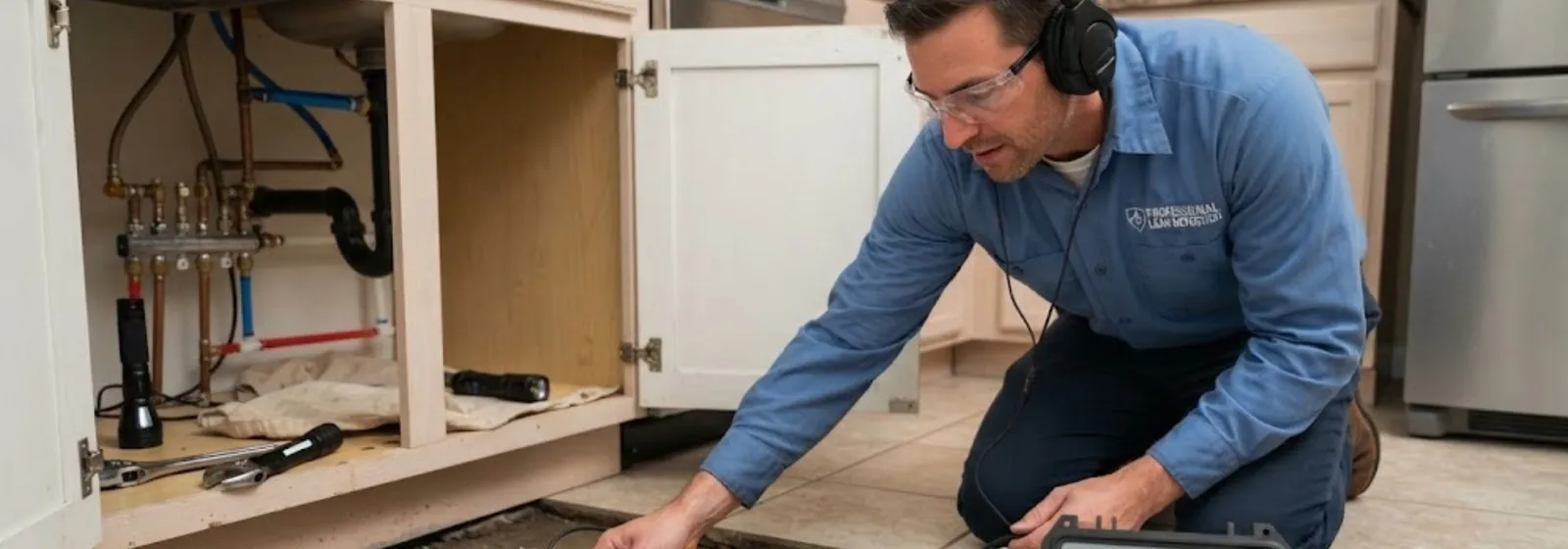
Acoustic listening
A sensitive ground microphone and a listening device pick up the hiss of escaping water through the slab.
- 4
Mark and report
We mark the likely spot on the floor, explain what we found and what we could not confirm, and answer your questions.
Our leak detection service uses these methods. Where sound is unclear, a second method such as a thermal check may be used to confirm the area. Detection tells you where and how likely, and it does not open anything.
Honest limits of detection
No tool is perfect through concrete. Very small leaks can be too quiet to hear, deep or insulated lines can muffle sound, and several leaks can confuse a reading. We say when a result is firm and when it is a best estimate.
What to do while you wait for a detection visit
Slab leaks are rarely a safety emergency, but some situations need action.
- Close the main valve if you hear a hiss or see water coming through the floor.
- Shut off power to wet areas at the breaker before touching anything damp.
- Move rugs and furniture off a warm or wet patch.
- Take a photo of the meter reading with the date.
- If you smell gas, leave the building and call the gas utility or 911 first.
After detection: the next conversation
Once the leak is located, you can decide what to do about it with full information. That conversation is covered by our slab leak repair page, and the choices depend on where the leak sits, the pipe material and how many lines are affected.
Royal Palm Beach note: bills, meters and permits
Water bills in the Village come from Palm Beach County Water Utilities, customer service (561) 740-4600. If your use jumps, ask the utility what the meter recorded, since a continuous flow pattern supports a leak. Addresses south of Southern Boulevard are served by Village of Wellington Utilities at (561) 791-4010.
The Village states that most work done in Royal Palm Beach requires a building permit. Call the Village building department at (561) 790-5128 before any work that breaks into the floor.
Source type: county utility customer service information and Village of Royal Palm Beach building department web page
Similar checks nearby
The meter test works the same way in Wellington, where homes also sit on a utility connection. On a private well, as in The Acreage, there is no street meter, so you watch the pump and pressure tank instead. Tell us about your setup when you call.
Call the 24/7 line and ask for a detection visit.
Sources and standards
Slab repairs and reroutes are governed by the Florida Building Code, Plumbing, 8th Edition (2023) and usually need a permit, and the Village of Royal Palm Beach states that most work in the Village does. Call (561) 790-5128 to confirm what your repair needs.
Slab leak detection in Royal Palm Beach
What are the first signs of a slab leak?
A meter that moves with everything off, a warm patch on the floor, the sound of water in a quiet house, or a bill that rises for no reason. One sign is a prompt to test. Two or more is a strong reason to call.
Can a slab leak be found without breaking the floor?
Yes. Detection uses pressure testing and listening equipment from the surface, so the concrete stays intact until a repair is chosen.
Is a slab leak the same as a plumbing emergency?
Not always. It rarely floods the house at once, but it can damage floors and raise bills quickly, so find it soon.
How do I tell a hot line from a cold line leak?
A warm floor patch points to hot. A cold line leak shows on the meter and as damp flooring without warmth. A pressure test separates the two.
Will the water utility help me find a leak?
Palm Beach County Water Utilities can tell you what the meter recorded, which helps. The line inside your property is yours to find, so call us for locating.
Question not answered here? Call the 24/7 line at (561) 448-8545 and talk to a plumber.