

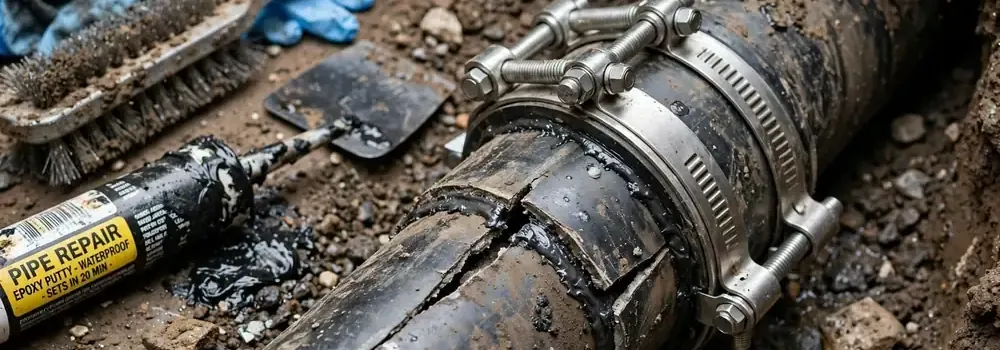
What drives the cost of sewer pipe lining
Lining cost is set by the pipe, not by the liner. The biggest movers are how long the run is, how deep it sits, the pipe diameter, how easy it is to reach both ends, and how much root or buildup has to be cleared first. We give a clear price before work starts, after a camera has shown what is actually in the pipe.
Lining means pulling a resin-soaked tube through the old pipe and curing it in place, so it hardens into a new pipe inside the old one. It suits a line that is cracked, rough, or leaking at joints but still follows a straight path. It does not fix a pipe that has collapsed, sunk into a low spot, or pulled apart. Those cases fall under sewer line repair by digging.
Lining, dig-and-replace and spot repair compared
| Factor | Pipe lining | Dig and replace | Spot repair |
|---|---|---|---|
| Length of pipe | Cost climbs with each added foot of liner | Cost climbs with every foot of trench | Small, since only one section is touched |
| Depth | Matters little, since access pits are small | Deeper trenches take more time and shoring | Depth decides how big the single dig is |
| Diameter | Larger pipe needs a larger liner | Larger pipe costs more per length | Minor effect |
| Access | Needs a cleanout or an opening at each end | Needs a clear path for equipment | Needs room at the one point |
| Roots and buildup | Must be cleared before the liner goes in | Removed along with the old pipe | Cleared only near the repair |
| Bends | Many bends make lining harder | Bends are easy to follow | Not a factor |
| Permits | Often needed, so ask the Village | Usually needed | Often needed |
| Restoration | Little or none | Driveway, lawn or slab repair can be large | Limited to one patch |
No row in that table makes one route the winner. A long, deep line under a driveway often favors lining because trench restoration is where dig-and-replace costs pile up. A short line with one broken joint may be cheaper as a single spot repair.
Why a camera comes before any price
Nobody can price a liner by looking at a cleanout cap. A camera on a push cable shows the pipe material, the number of bends, where roots enter, and whether any section has dropped. That footage decides which of the three routes is even possible, which is why the camera visit usually happens first.
Our plumbers can do that look through our sewer inspection service and then talk through the findings with you. If the footage shows a belly, which is a low section that holds water, lining will not correct the slope. In that case the honest answer is a spot repair or replacing that run.
Is the sewer line yours to repair?
Royal Palm Beach note: whose pipe is it
Homes in the Village of Royal Palm Beach are on county sewer, served by Palm Beach County Water Utilities, whose customer service number is (561) 740-4600. The mains under the street belong to the utility. The line that runs from your house to that main is a separate matter, so confirm with the utility where its responsibility ends before you pay for any work.
Addresses south of Southern Boulevard are served by Village of Wellington Utilities, (561) 791-4010, according to the Village's water-bill FAQ. If your home sits near that line, make that call first. A repair priced against the wrong owner's pipe wastes everyone's time.
Source type: county utility customer service information and the Village clerk's water-bill FAQ
Signs the line may need more than a cleaning
Backups that return
A clog cleared with a cable that returns within weeks often points to roots or a damaged section. That pattern deserves a camera, not another cable run.
Slow drains in several fixtures
When the tub, the toilets and the kitchen all slow down together, suspect the shared line. One fixture alone usually has a local clog.
Gurgling at a floor drain
Air moving backward through a floor drain or toilet is a hint. Wastewater may not be flowing freely downstream.
Wet or sunken ground
Damp soil or a dip in the lawn along the pipe path can mean a leaking joint. It can also mean a collapse.
Septic homes are a different case
Lining advice in this post applies to homes on a county sewer connection. If you are in a nearby wells-and-septic area such as Loxahatchee Groves, where the Town says it provides no water or sewer service, the problem is usually a tank, a drain field or the pipe between them. Lining does not treat a septic tank, and a camera on the house line is a different job from the one described here.
Homes in Wellington south of Southern Boulevard have their own utility, so the ownership question above applies there as well. Call us and we will say plainly whether lining makes sense for your setup or whether it does not.
Questions to ask before you approve a lining job
Checklist before you agree to lining
A clear answer to each item protects you from paying for a repair that does not fit the pipe.
- Ask to see the camera footage of the whole run, not a still photo.
- Ask how roots and buildup will be cleared before the liner goes in.
- Ask whether the liner covers the full length or only part of it.
- Ask who pulls the permit and what the Village building department says about it.
- Ask what happens at the connection to the main and at each cleanout.
- Ask for the price in writing before work begins.
These five things shape any sewer repair quote.
Length of the run
Every added foot means more liner or more trench, so the footage from house to main sets the baseline.
Depth and access
A deep line or one with no cleanout at either end needs extra digging before any repair begins.
Pipe diameter and condition
Larger pipe takes more material, and heavy scale or root growth adds cleaning time first.
Bends and offsets
Many turns make a liner harder to install and sometimes rule it out.
Permits and restoration
Permit rules vary, so ask the Village building department. Restoration of concrete, pavers or landscaping can outweigh the repair itself.
Insurance may or may not cover sewer work, so check your policy. Call (561) 448-8545 and you will get a clear price before work starts.
Sources and standards
Repairs and replacements follow the Florida Building Code, Plumbing, 8th Edition (2023) as the governing standard, and the Village of Royal Palm Beach says most work in the Village requires a permit. Call the building department at (561) 790-5128 before any dig.
Sewer pipe lining questions in Royal Palm Beach
Can every damaged sewer pipe be lined?
No. Lining works best in a pipe that is cracked, rough or leaking at joints but still holds its shape and slope. A collapsed pipe, a heavy belly or a joint that has pulled apart usually needs a dig.
Does lining require digging up my yard?
Usually much less than replacement. Crews work through a cleanout or a small access pit, so the lawn and driveway often stay mostly intact. If the camera shows a failure the liner cannot span, a limited dig may still be needed.
Who do I call if the street main is backed up and not just my line?
If other houses on your street are affected, call Palm Beach County Water Utilities at (561) 740-4600 since the mains are the utility's. If only your house is backing up, call us and we will check the line on your property.
Is it worth lining a short sewer line with one bad spot?
Often a spot repair is the better fit when damage is limited to one joint or one short section. A camera tells us whether the rest of the pipe is sound enough to leave alone.
Does a Royal Palm Beach home on county sewer ever need a septic-style fix?
No. Tank and drain field work belongs to septic homes, which are found in nearby unincorporated areas rather than on the county sewer system. Tell us your address on the call and we will confirm which setup you have.
Question not answered here? Call the 24/7 line at (561) 448-8545 and talk to a plumber.