

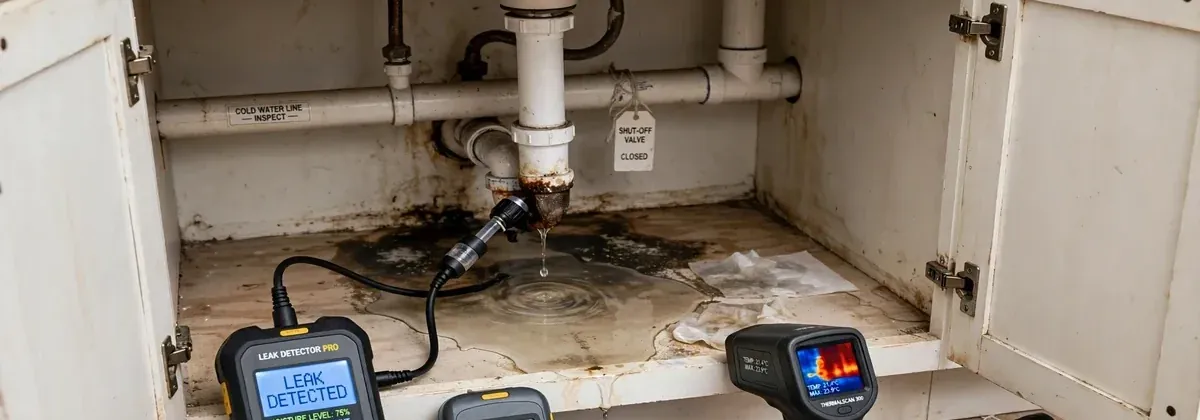
Step one: the meter test
- 1
Shut everything off
Close every tap, stop the dishwasher and washer, and make sure no one flushes. Turn off the irrigation timer and any ice maker or humidifier on a water line.
- 2
Find and open the meter box
Meters usually sit in a ground box near the curb or property line. Lift the lid carefully, since insects and debris collect inside, and wipe the face clean.
- 3
Read the leak indicator
Many meters have a small triangle, star or low-flow dial that spins at the slightest flow. If it moves with all water off, you have a leak. If it stays still, the leak may be intermittent.
- 4
Close the house valve and recheck
Shut the main valve where the line enters the house. If the meter indicator stops, the leak is inside. If it keeps moving, the leak is in the line between the meter and the house, often underground.
Take a photo of the meter face before and after thirty minutes without water use. A change in the numbers confirms flow even if the indicator is hard to see. This is the single most useful test, and it is free.
Where hidden leaks hide
| Meter result | Likely area | What to check next |
|---|---|---|
| Moves with house valve open and closed | Yard line from meter to house | Wet spots, lush patches, sound of running water |
| Stops when house valve closes | Inside plumbing or fixtures | Toilets, faucets, water heater, irrigation tie-in |
| Moves only when a toilet tank refills | Toilet flapper or fill valve | Dye test |
| Moves in short bursts every few minutes | Slow leak at a fixture or softener | Check under sinks and the heater |
| Still, but the bill is high | Usage, irrigation or billing period | Review irrigation and household changes |
The toilet dye test
A leaky flapper lets water trickle into the bowl without a sound. Drop a few drops of food coloring into the tank, wait fifteen minutes without flushing, then look at the bowl. Color in the bowl means the flapper is leaking.
Replacing a flapper is a simple job, and our toilet repair page covers fill valves and tanks that need more than a flapper. Check every toilet in the house, including guest baths used rarely.
Irrigation and the sprinkler system
Sprinkler systems use more water than most indoor fixtures. A stuck valve, a broken head or a timer set too long can run up a bill without any visible puddle. Run each zone and look for geysers, soggy ground or low spots.
The South Florida Water Management District bans irrigation between 10 am and 4 pm all year, so a system that runs at midday is also out of compliance. Set the timer outside that window. We do not state watering days here, since local schedules can change.
The water heater and other quiet leaks
The relief valve discharge pipe near your heater can drip steadily if pressure is high. Look at the end of that pipe and the pan below the unit. A softener, ice maker line or hose bib can also seep unseen.
Feel for damp spots on cabinet floors under sinks. Look at walls and ceilings for stains, which show up days after the leak starts.
Signs of a slab leak
Water under a concrete slab does not show on the surface at first.
- A warm spot on the floor with no heating system running
- The sound of water running when everything is off
- Damp carpet, lifting tile or musty smell with no visible source
- Meter moving even when the house valve is closed
- Weak hot water pressure that comes and goes
A suspected slab leak needs electronic location before anyone cuts concrete. Our leak detection team uses acoustic listening gear and pressure tests to pinpoint the spot. For repairs under the floor, the slab leak repair page explains the options of repair, rerouting or repiping.
Royal Palm Beach note: who bills you and who to call
Palm Beach County Water Utilities serves the Village and answers customer questions at (561) 740-4600. The Village's billing FAQ says addresses south of Southern Blvd are served by Wellington Utilities at (561) 791-4010.
The utility can tell you which bill period carried the extra usage, which helps date the leak. We do not state rates here, since they change and your bill is the source. Ask the utility whether any adjustment process exists for a repaired leak.
Source type: Village government pages and county utility contact information
When to call a plumber
Call if the meter moves with the house valve closed, if you hear water but cannot find it, or if a floor is warm. A buried line leak cannot be fixed by guessing. The caller gets a clear price before work starts.
Homes outside the county system do not receive a utility bill at all. In Loxahatchee Groves, most residents rely on private wells, so a high electric bill from a well pump running nonstop is the clue to check. In Wellington, the village utility and the county serve different sides of State Road 7, so confirm your provider before calling about a bill.
Sources and standards
The South Florida Water Management District rule bars irrigation from 10 am to 4 pm, and Palm Beach County Water Utilities, at (561) 740-4600, answers billing questions. Repairs follow the Florida Building Code, Plumbing, 8th Edition (2023).
Royal Palm Beach high water bill questions
How do I know if my meter is showing a leak?
Turn off all water use and watch the leak indicator or the smallest dial. If it moves, water is flowing somewhere.
What should I check first if my water bill doubles?
Run the meter test, then dye test the toilets, then look at the irrigation system. Those three explain most sudden jumps.
Can a slab leak raise my water bill without any signs?
Yes. Small slab leaks can run for weeks without damage you can see. A moving meter with the house valve closed is the clue.
Does the county water utility explain high usage?
Call (561) 740-4600 for your account. The utility can compare past bill periods. Addresses south of Southern Blvd use Wellington Utilities instead.
I water my lawn at night. Could that explain it?
It could. The SFWMD rule bans irrigation from 10 am to 4 pm, so night watering is allowed, but a stuck zone can still run too long. Check each zone.
Will a plumber find a buried yard leak without digging everywhere?
Usually yes. Pressure testing and acoustic detection narrow it to a small area before any digging starts.
Question not answered here? Call the 24/7 line at (561) 448-8545 and talk to a plumber.