
Short answer: what a tankless flush actually is
A flush is a descaling service. Water passes through a narrow heat exchanger inside the unit, and minerals in that water slowly bake onto the metal as a crust. A mild acid solution, often white vinegar or a descaler the maker approves, dissolves that crust so heat can move into the water again.
Most owners can handle the job if the unit has service valves. Without them, a plumber has to add a valve set first. That small upgrade makes every future flush faster, and our tankless water heater service visits often start there.
Why scale builds up inside a tankless unit
Hot water drives dissolved calcium and magnesium out of solution. In a tank heater the scale settles on the floor of the tank. A tankless unit has no tank, so the scale lands on the heat exchanger itself, where the passages are only a few millimeters wide.
Water hardness decides how fast this happens, and the Palm Beach County Water Utilities reports we have reviewed do not publish a hardness figure. So we will not guess at one for your street. Ask the utility at (561) 740-4600 or test your own tap with a hardness strip.
| What you notice | Likely cause | First move |
|---|---|---|
| Hot water turns lukewarm at low flow | Scale narrowing the heat exchanger | Check the manual, plan a flush |
| Error code on the display | Flow or temperature fault from buildup | Look up the code, then flush |
| Rumbling or popping while heating | Scale trapping tiny pockets of steam | Flush soon, do not ignore |
| Water flow is weak only on hot | Clogged inlet filter or scale | Clean the filter first |
| Unit shuts off mid-shower | Safety limit tripped by poor heat transfer | Flush, then call if it repeats |
The flush, step by step
- 1
Power down and close the water
Turn off the electric breaker, or switch a gas unit to off at its control. Close the cold and hot isolation valves under the unit. Open a hot tap somewhere in the house to relieve pressure.
- 2
Connect the hose and pump
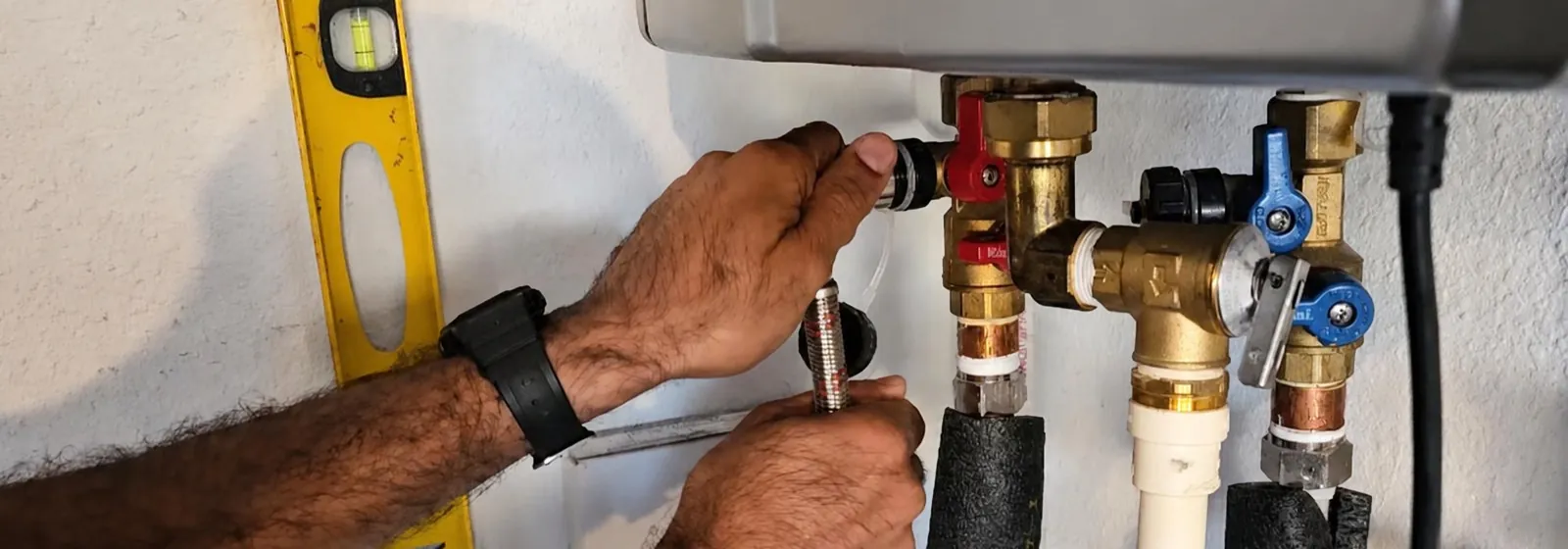
Attach one hose to the cold service port and one to the hot port, then run them to a bucket and a small submersible pump. Pour in the descaling solution your manual recommends. Open the service ports so the solution can circulate.
- 3
Circulate for the time the manual states
Run the pump for the period printed in your manufacturer's instructions. We will not name a number here, because it differs between brands and models. Stopping early leaves scale behind, and running long can attack seals.
- 4
Rinse and clean the inlet filter
Drain the solution, then flush the unit with clean water until it runs clear and smells neutral. Pull the small screen at the cold inlet, rinse it, and reinstall it. Close the service ports, reopen the isolation valves, and restore power.
Before you start: safety checklist
Descaling is simple, but a few details cause most of the damage we see.
- Use only the solution your manufacturer lists. Some seals do not tolerate strong acids.
- Cut the power before closing the water, or the unit can fire with no flow.
- Never run a pump dry. Keep the intake submerged.
- If you smell gas at any point, leave the building and call the gas utility or 911 first, then call us.
- Wear eye protection, since descaling fluid splashes.
Flush yourself or call a plumber
A DIY flush makes sense when
- Service valves are already installed
- The unit is accessible and the manual is on hand
- You are comfortable closing valves and reading a manual
- The only symptom is slow decline in hot water output
Call a plumber when
- There are no service valves to connect a hose to
- The unit leaks, smells of gas, or shows a repeating error after a flush
- The flush has not been done in a long time and flow is already poor
- You want the vent, gas line and water pressure checked at the same visit
A unit that has gone untouched for a long time can have scale hard enough that a short circulation will not clear it. That is a judgment call best made by someone who can look at the exchanger and test flow rates. Our water heater repair crews also check venting and gas connections while they are there.
How often should you flush
The manufacturer sets the interval, and many manuals tie it to water hardness and usage. Homes with harder water or a recirculation loop usually need attention more often. Since the local hardness number is something you have to request, treat your first flush as a test and see how much scale comes out.
Also clean the inlet filter between flushes. It catches grit after plumbing work or a utility main flush, and a blocked screen mimics scale symptoms. It takes a few minutes and costs nothing.
Royal Palm Beach note: your water and your flush
Palm Beach County Water Utilities supplies water in the Village, and its water quality report names the Biscayne Aquifer as the source for the eastern system. The disinfectant is chloramine, and the utility switches to free chlorine twice a year for pipe cleaning.
Addresses south of Southern Blvd are served by Wellington Utilities at (561) 791-4010 instead, so call the right utility if you want hardness information. If a plumber replaces valves or changes the unit, call the Village building department at (561) 790-5128 about permits.
Source type: county utility water quality report and Village government pages
When a flush will not fix it
A flush removes scale. It does not repair a cracked exchanger, a failed flow sensor, a bad igniter or a clogged vent. If the error code returns within days, the cause was not scale.
Homes on private wells, such as parts of The Acreage, often see sediment on top of scale. In Wellington, where the village and nearby areas mix different utilities, the supply can differ block to block. In both cases, the inlet filter and a basic water test tell you more than a guess.
Sources and standards
Tankless units are installed to the Florida Building Code, Plumbing, 8th Edition (2023) and the manufacturer's written instructions, which set the flush and descale routine. The Village of Wellington states that tankless or solar units need plan review, so ask your building department what applies.
Royal Palm Beach tankless flush questions
How long do I run the vinegar through a tankless heater?
It depends on the model. Follow your manufacturer's instructions for the circulation time, because the number differs between brands and some manuals call for a descaler rather than vinegar.
Can a flush damage my tankless water heater?
It can if you use the wrong fluid, skip the power shutoff or run the pump dry. Sticking to the manual's solution and steps keeps the risk low.
Is the water hardness in Royal Palm Beach high enough to need frequent flushes?
We cannot give you a number. The county utility reports we reviewed do not publish hardness, so call the utility at (561) 740-4600 or test your tap. Your first flush will also show how much scale has formed.
Do I need a permit to flush a tankless heater here?
A flush is maintenance and does not usually change the installation. Replacing or relocating the unit is different, so call the Village building department at (561) 790-5128 before that work.
What if my unit has no service valves?
Then there is nothing to attach a hose to. A plumber can add a valve set, which makes later flushes a short job.
Which Royal Palm Beach streets have the hardest water?
No published source breaks hardness down by street, and we do not guess. Ask the utility, or compare strip tests from your own taps.
Question not answered here? Call the 24/7 line at (561) 448-8545 and talk to a plumber.